Prosiect Bontnewydd: Sustainable School Design Case Study
A new low-carbon primary school with integrated community centre, designed to push the boundaries of sustainable educational design.
Introduction
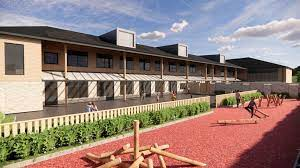
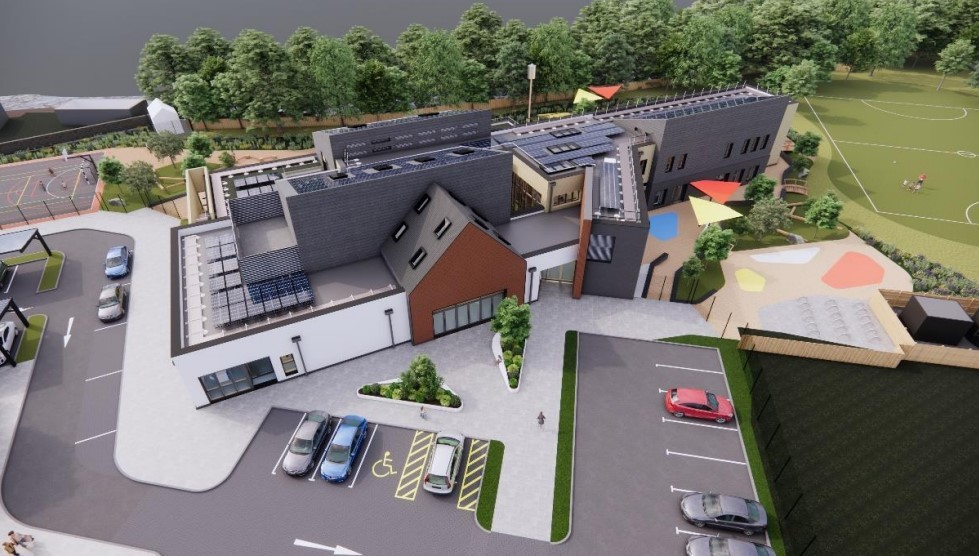
Prosiect Bontnewydd is an ambitious project designing and constructing a new low-carbon primary school with an integrated community centre in Gwynedd, Wales. The development required the demolition of the existing 1970s school building, and the adjacent Victorian Community Centre to make way for a modern, more sustainable facility.
With a strong commitment to achieve at least carbon neutrality, the project team prioritised reducing embodied carbon impacts at every stage of this sustainable school design. LCD Consulting played a key role in this effort, providing expert guidance on material selection to ensure sustainability and efficiency.
Measuring Embodied Carbon in Construction
The initial design assessment using conventional construction methods — including load-bearing masonry, ground-bearing slab, and standard internal finishes — revealed an embodied carbon total of over 1000 kgCO₂e/m². This exceeded industry benchmarks and highlighted the critical impact of material choices on carbon emissions.
This figure is above typical benchmarks, not only due to the specification of conventional materials, but also because of the building's inefficient form. If the initial design we were faced with had been a more standardised or compact shape, the embodied carbon figure may have been much closer to a typical school's benchmark. This underscores the importance of considering form alongside materials at the earliest stages of design, where decisions can have the greatest impact on reducing emissions.
By re-evaluating materials and construction techniques, Prosiect Bontnewydd successfully reduced embodied carbon. The most impactful changes were in superstructure and substructure design, where key material considerations significantly lowered emissions. We outline key material considerations and their impacts in the tables below.
Sustainable Material Choices & Carbon Savings
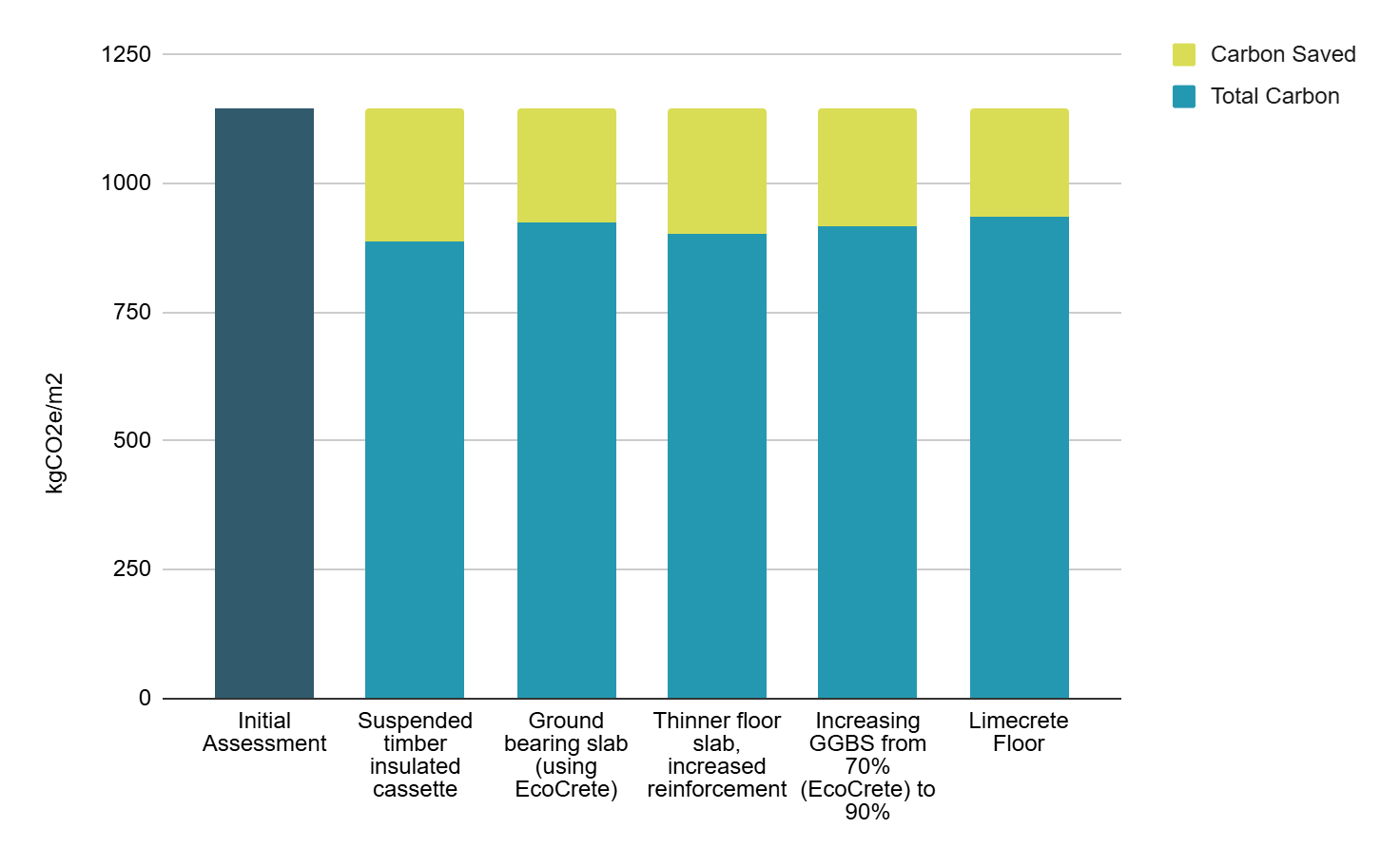
Lowest Floor
| Material Option | Lifecycle Carbon Change (kgCO₂e/m²) | % of Embodied Carbon Saved | Advantages | Disadvantages | Design Issues and Constraints |
|---|---|---|---|---|---|
| Suspended timber insulated cassette | -256 | 22.4% | Timber is one of the best alternatives, natural materials to use in construction, especially when recycled at its end of life. | Timber flooring can be more expensive than alternatives and may not be suitable for intricate layouts. | GGBS locally sourced is great, however, there has been increasingly more imported which negates the reductions from using these cement mixes. |
| Ground bearing slab (using EcoCrete) | -221 | 19.3% | Would require load-bearing considerations and could affect external floor to internal floor height changes. | EcoCrete is a Heidelberg concrete mix that uses around 70% GGBS, meaning its much more environmentally friendly. | GGBS content can increase the curing time of concrete, so it is dependent on time constraints as well as the contractor's supply. |
| Thinner floor slab, increased reinforcement | -21 (on top of ground bearing slab savings) | 2.4% additional | Reducing materials is one of the ideal ways to reduce embodied carbon, especially reducing concrete usage. | This is fully dependent on the load the floor is bearing and is not always completely possible. | Increasing the GGBS content will again increase the curing time so it will be dependent on time constraints and contractor's supply. |
| Increasing GGBS from 70% (EcoCrete) to 90% | -7 (on top of ground bearing slab savings) | 0.8% additional | Due to Limecrete's breathability, the materials placed on top must also be breathable. | Where the increased GGBS is sourced would be of concern. | Increasing GGBS content will ultimately help reduce the carbon footprint of the concrete. |
| Limecrete Floor | -209 | 18.3% | Limecrete floors are breathable and durable with lower impacts than standard concrete. | Due to Limecrete's breathability, the materials placed on top must also be breathable. | In comparison to the high GGBS concrete, Limecrete's impacts on the embodied carbon are not as desirable. |
Suspended timber insulated cassette
- Lifecycle Carbon Change (kgCO₂e/m²)
- -256
- % of Embodied Carbon Saved
- 22.4%
Show detailHide detail
Advantages
Timber is one of the best alternatives, natural materials to use in construction, especially when recycled at its end of life.
Disadvantages
Timber flooring can be more expensive than alternatives and may not be suitable for intricate layouts.
Design Issues and Constraints
GGBS locally sourced is great, however, there has been increasingly more imported which negates the reductions from using these cement mixes.
Ground bearing slab (using EcoCrete)
- Lifecycle Carbon Change (kgCO₂e/m²)
- -221
- % of Embodied Carbon Saved
- 19.3%
Show detailHide detail
Advantages
Would require load-bearing considerations and could affect external floor to internal floor height changes.
Disadvantages
EcoCrete is a Heidelberg concrete mix that uses around 70% GGBS, meaning its much more environmentally friendly.
Design Issues and Constraints
GGBS content can increase the curing time of concrete, so it is dependent on time constraints as well as the contractor's supply.
Thinner floor slab, increased reinforcement
- Lifecycle Carbon Change (kgCO₂e/m²)
- -21 (on top of ground bearing slab savings)
- % of Embodied Carbon Saved
- 2.4% additional
Show detailHide detail
Advantages
Reducing materials is one of the ideal ways to reduce embodied carbon, especially reducing concrete usage.
Disadvantages
This is fully dependent on the load the floor is bearing and is not always completely possible.
Design Issues and Constraints
Increasing the GGBS content will again increase the curing time so it will be dependent on time constraints and contractor's supply.
Increasing GGBS from 70% (EcoCrete) to 90%
- Lifecycle Carbon Change (kgCO₂e/m²)
- -7 (on top of ground bearing slab savings)
- % of Embodied Carbon Saved
- 0.8% additional
Show detailHide detail
Advantages
Due to Limecrete's breathability, the materials placed on top must also be breathable.
Disadvantages
Where the increased GGBS is sourced would be of concern.
Design Issues and Constraints
Increasing GGBS content will ultimately help reduce the carbon footprint of the concrete.
Limecrete Floor
- Lifecycle Carbon Change (kgCO₂e/m²)
- -209
- % of Embodied Carbon Saved
- 18.3%
Show detailHide detail
Advantages
Limecrete floors are breathable and durable with lower impacts than standard concrete.
Disadvantages
Due to Limecrete's breathability, the materials placed on top must also be breathable.
Design Issues and Constraints
In comparison to the high GGBS concrete, Limecrete's impacts on the embodied carbon are not as desirable.
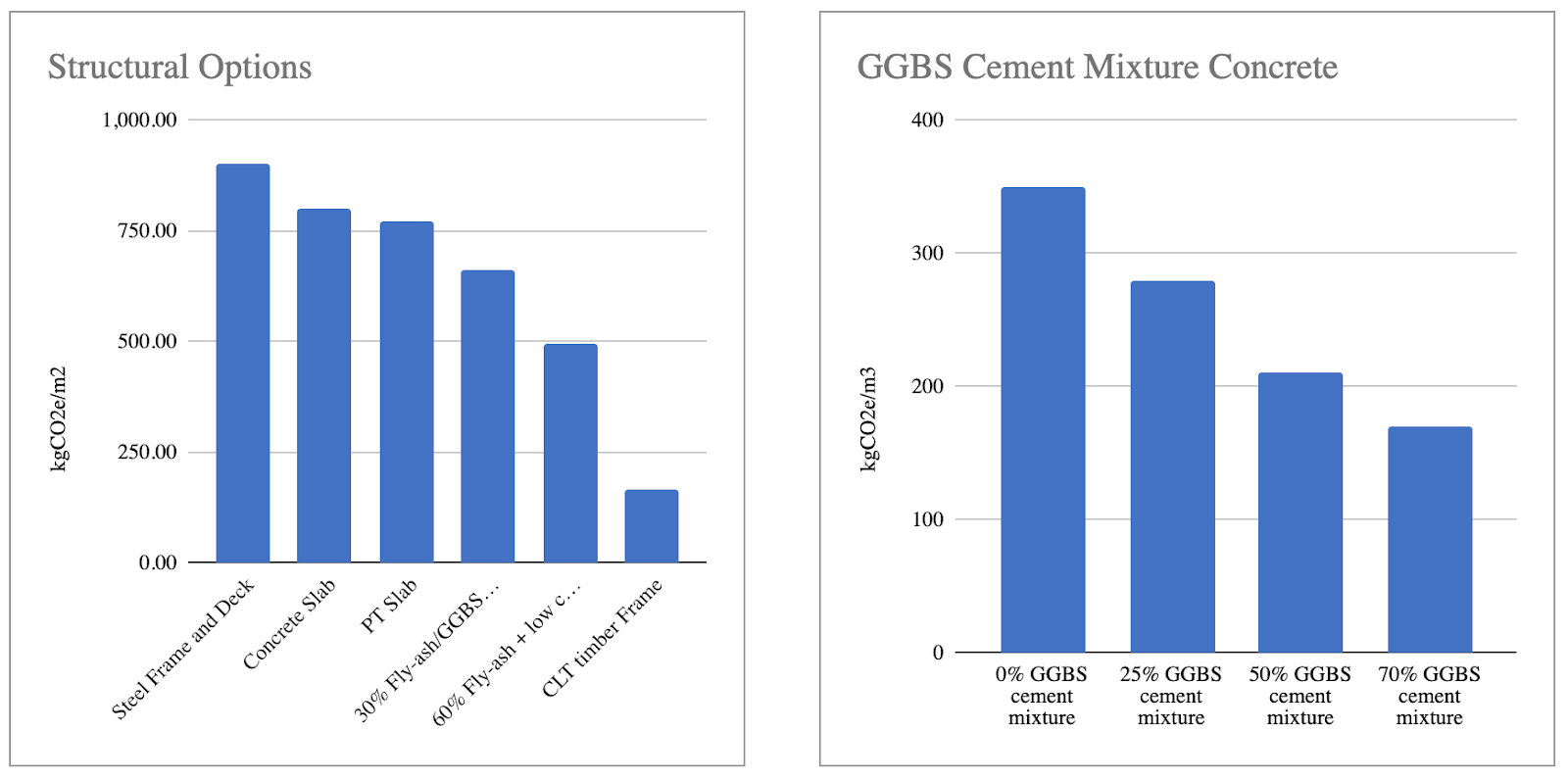
Incorporating Ground Granulated Blast Furnace Slag (GGBS) into a concrete mix is one of the most effective ways to reduce the carbon footprint of a project. When sourced within the UK, GGBS offers significant environmental benefits, as outlined in its advantages and disadvantages. However, importing GGBS from overseas can offset these gains due to the emissions associated with transportation.
The graph below illustrates the impact of varying GGBS percentages on the embodied carbon of cement mix per m², highlighting the potential embodied carbon reductions achievable through strategic material selection.
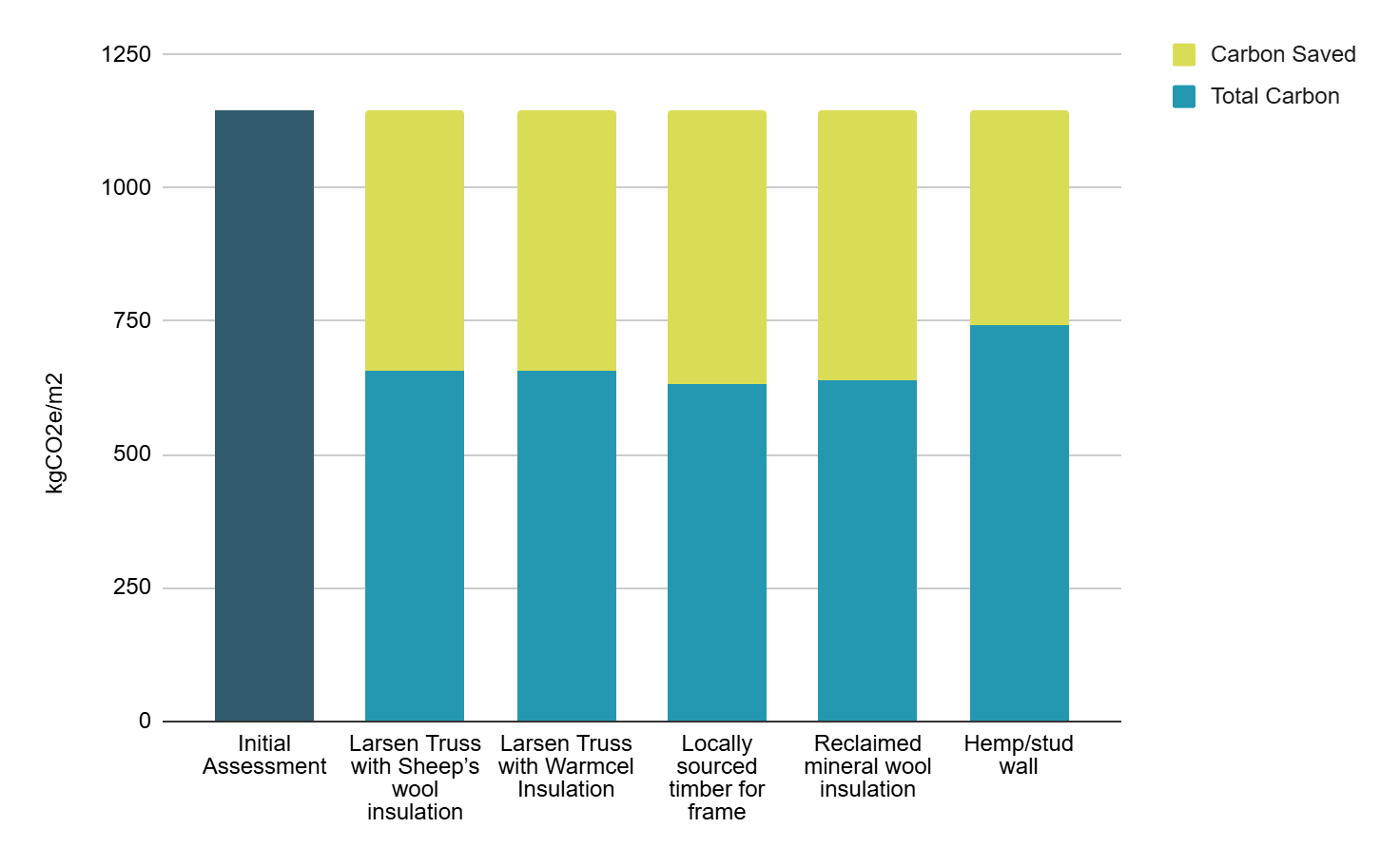
Low-Carbon Superstructure Options
| Material Option | Lifecycle Carbon Change (kgCO₂e/m²) | % of Embodied Carbon Saved | Advantages | Disadvantages | Design Issues and Constraints |
|---|---|---|---|---|---|
| Larsen Truss with Sheep's wool insulation | -488 | 42.6% | Still using the Larsen Truss is advantageous for the project. Sheep's Wool is a resource local to the site so would have lower transport impacts potentially. | Sheep wool, despite the proposed lower travel impacts, has a higher impact than Warmcel. | Although it was mentioned to potentially use sheep's wool, it was preferred by the design team to use Warmcel due to carrying thicknesses required for wall u-values. |
| Larsen Truss with Warmcel Insulation | -486 | 42.4% | Larsen trusses are made of timber making them optimal for embodied carbon. Warmcel insulation is a product made from waste with minimal additives making it a low carbon insulation option. | Where the timber is sourced from could affect the carbon savings. | This was a preferred option by the design team due to its ease of construction and low carbon results. |
| Locally sourced timber for frame | -25 (on top of the Larsen Truss savings respectively) | 3.8% additional | Using locally sourced materials reduces the impact of travel on the embodied carbon. It encourages local economic circularity. | Large span load bearing timber cannot always be sourced within the UK and must come from Europe. | This option is dependent on the demand of the local supplier and the time constraints involved. |
| Reclaimed mineral wool insulation | -18 (on top of the Larsen Truss and Warmcel savings) | 2.7% additional | Reclaiming materials follows the circular economy approach and massively reduces embodied carbon. | The condition of reclaimed materials can be an issue when achieving certain U-values and strengths. There is also a lack of supply for some high demand reclaimed materials. | It would be dependent on the supply locally available, as outsourcing too far would negate the reductions. |
| Hemp/stud wall | -400 | 34.9% | Hemp is a natural material that helps control vapour in a space and keeps carbon impacts low. | Hempcrete is not load-bearing and requires extra structure when used. | The extra structure involved made the carbon outcome higher than the Larsen Truss option making it not as desirable. |
Larsen Truss with Sheep's wool insulation
- Lifecycle Carbon Change (kgCO₂e/m²)
- -488
- % of Embodied Carbon Saved
- 42.6%
Show detailHide detail
Advantages
Still using the Larsen Truss is advantageous for the project. Sheep's Wool is a resource local to the site so would have lower transport impacts potentially.
Disadvantages
Sheep wool, despite the proposed lower travel impacts, has a higher impact than Warmcel.
Design Issues and Constraints
Although it was mentioned to potentially use sheep's wool, it was preferred by the design team to use Warmcel due to carrying thicknesses required for wall u-values.
Larsen Truss with Warmcel Insulation
- Lifecycle Carbon Change (kgCO₂e/m²)
- -486
- % of Embodied Carbon Saved
- 42.4%
Show detailHide detail
Advantages
Larsen trusses are made of timber making them optimal for embodied carbon. Warmcel insulation is a product made from waste with minimal additives making it a low carbon insulation option.
Disadvantages
Where the timber is sourced from could affect the carbon savings.
Design Issues and Constraints
This was a preferred option by the design team due to its ease of construction and low carbon results.
Locally sourced timber for frame
- Lifecycle Carbon Change (kgCO₂e/m²)
- -25 (on top of the Larsen Truss savings respectively)
- % of Embodied Carbon Saved
- 3.8% additional
Show detailHide detail
Advantages
Using locally sourced materials reduces the impact of travel on the embodied carbon. It encourages local economic circularity.
Disadvantages
Large span load bearing timber cannot always be sourced within the UK and must come from Europe.
Design Issues and Constraints
This option is dependent on the demand of the local supplier and the time constraints involved.
Reclaimed mineral wool insulation
- Lifecycle Carbon Change (kgCO₂e/m²)
- -18 (on top of the Larsen Truss and Warmcel savings)
- % of Embodied Carbon Saved
- 2.7% additional
Show detailHide detail
Advantages
Reclaiming materials follows the circular economy approach and massively reduces embodied carbon.
Disadvantages
The condition of reclaimed materials can be an issue when achieving certain U-values and strengths. There is also a lack of supply for some high demand reclaimed materials.
Design Issues and Constraints
It would be dependent on the supply locally available, as outsourcing too far would negate the reductions.
Hemp/stud wall
- Lifecycle Carbon Change (kgCO₂e/m²)
- -400
- % of Embodied Carbon Saved
- 34.9%
Show detailHide detail
Advantages
Hemp is a natural material that helps control vapour in a space and keeps carbon impacts low.
Disadvantages
Hempcrete is not load-bearing and requires extra structure when used.
Design Issues and Constraints
The extra structure involved made the carbon outcome higher than the Larsen Truss option making it not as desirable.
Low-Carbon Substructure Options
Modelled using Larsen Truss with Warmcel insulation as the chosen superstructure.
| Material Option | Lifecycle Carbon Change (kgCO₂e/m²) | % of Embodied Carbon Saved | Advantages | Disadvantages | Design Issues and Constraints |
|---|---|---|---|---|---|
| Traditional strip footings using EcoCrete | -21 | 3.2% | These are commonly used foundations that are simple and cost effective. | They are susceptible to flooding as they do not go far enough below ground and are typically not as strong as other foundation types. | Although lower in carbon than the insulated system, the disadvantages would cause potential uplift in operational carbon in the long term. |
| Insulated foundation system using EPS | -5 | 0.8% | Helps reduce the operational carbon through better floor U-values. | Requires an increase in material use. EPS is a high impact material. | There are not many insulations suitable for below ground construction due to the moisture and load bearing conditions. |
| Insulated foundation system using Glapor | -15 (compared to EPS system) | 2.3% | Glapor is a recycled foam glass material that has lower carbon impacts compared to EPS, and can provide damp protection. | This can be more expensive than other insulations and requires specific handling due to its brittle nature. | Glapor foamed glass insulation has the same abilities as EPS but with a lower carbon, making it a preferred option. |
Traditional strip footings using EcoCrete
- Lifecycle Carbon Change (kgCO₂e/m²)
- -21
- % of Embodied Carbon Saved
- 3.2%
Show detailHide detail
Advantages
These are commonly used foundations that are simple and cost effective.
Disadvantages
They are susceptible to flooding as they do not go far enough below ground and are typically not as strong as other foundation types.
Design Issues and Constraints
Although lower in carbon than the insulated system, the disadvantages would cause potential uplift in operational carbon in the long term.
Insulated foundation system using EPS
- Lifecycle Carbon Change (kgCO₂e/m²)
- -5
- % of Embodied Carbon Saved
- 0.8%
Show detailHide detail
Advantages
Helps reduce the operational carbon through better floor U-values.
Disadvantages
Requires an increase in material use. EPS is a high impact material.
Design Issues and Constraints
There are not many insulations suitable for below ground construction due to the moisture and load bearing conditions.
Insulated foundation system using Glapor
- Lifecycle Carbon Change (kgCO₂e/m²)
- -15 (compared to EPS system)
- % of Embodied Carbon Saved
- 2.3%
Show detailHide detail
Advantages
Glapor is a recycled foam glass material that has lower carbon impacts compared to EPS, and can provide damp protection.
Disadvantages
This can be more expensive than other insulations and requires specific handling due to its brittle nature.
Design Issues and Constraints
Glapor foamed glass insulation has the same abilities as EPS but with a lower carbon, making it a preferred option.
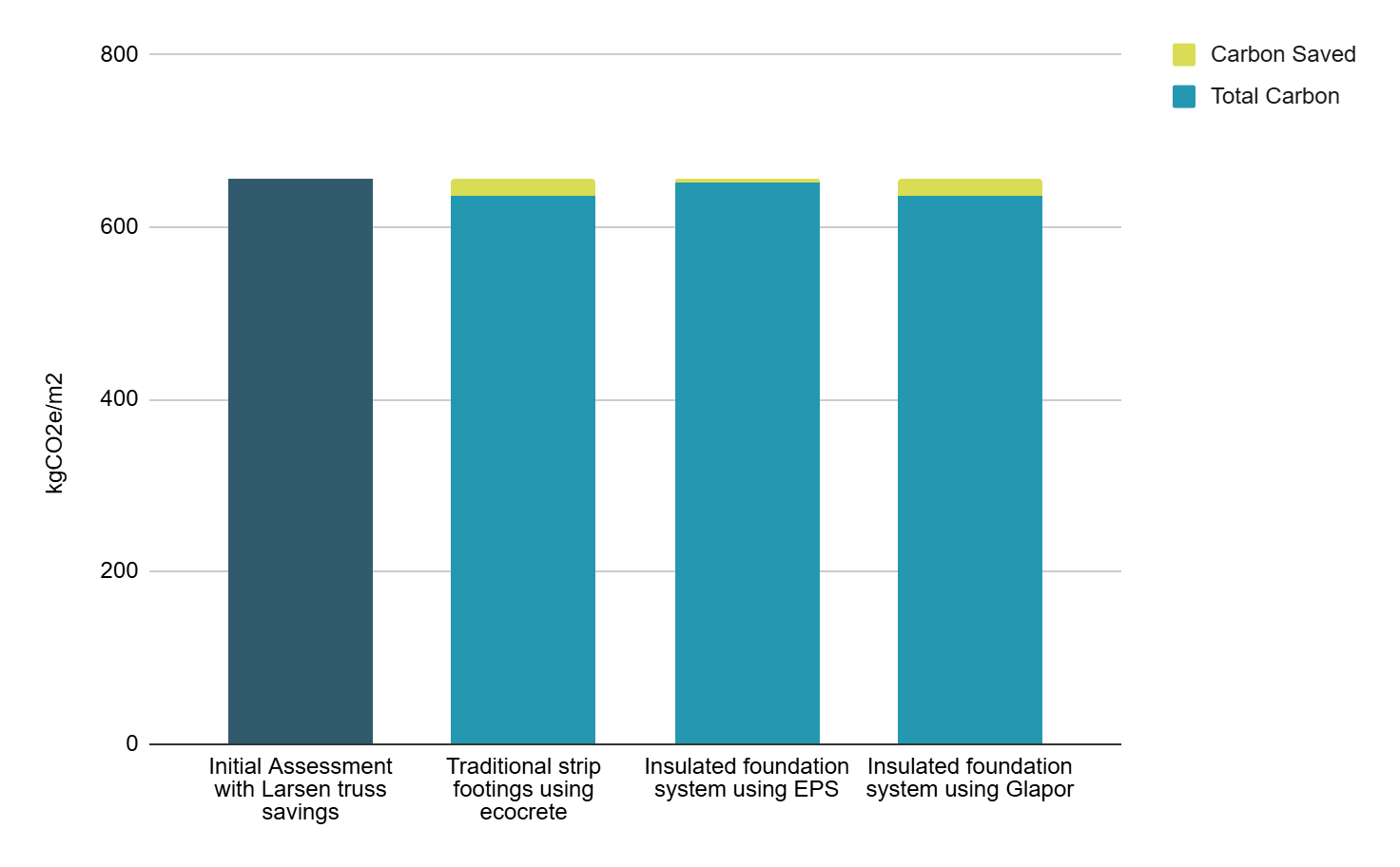
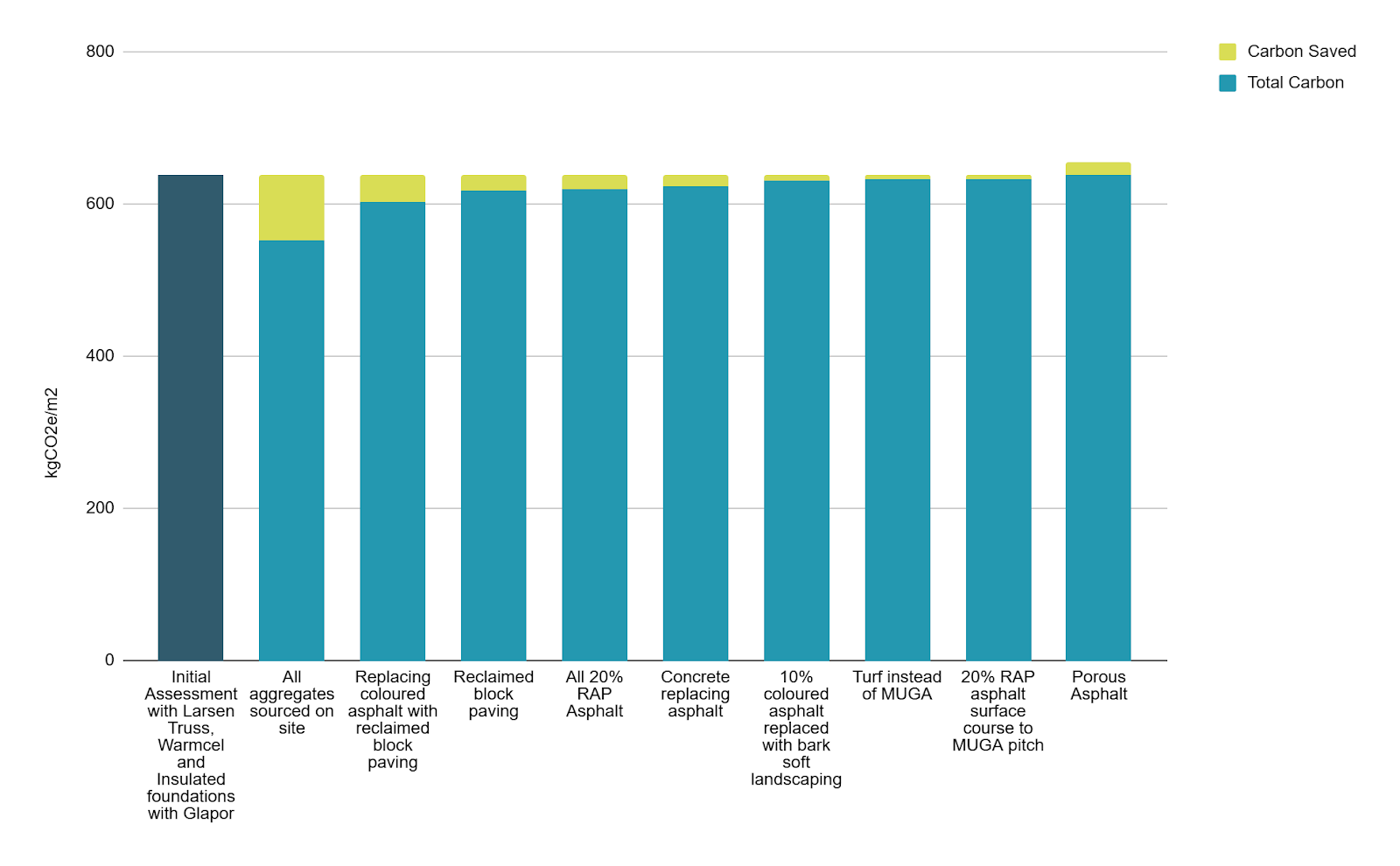
Since the external works were managed by a separate team, LCD Consulting's involvement in optimising these elements came after key building design decisions had already been made. Thus, these options were considered with a baseline model totalling under 700 kgCO₂e/m².
Through this modelling of the scheme, our team found that the external works made up almost 40% of the total embodied carbon. We explored alternative material solutions and construction approaches to further reduce environmental impact.
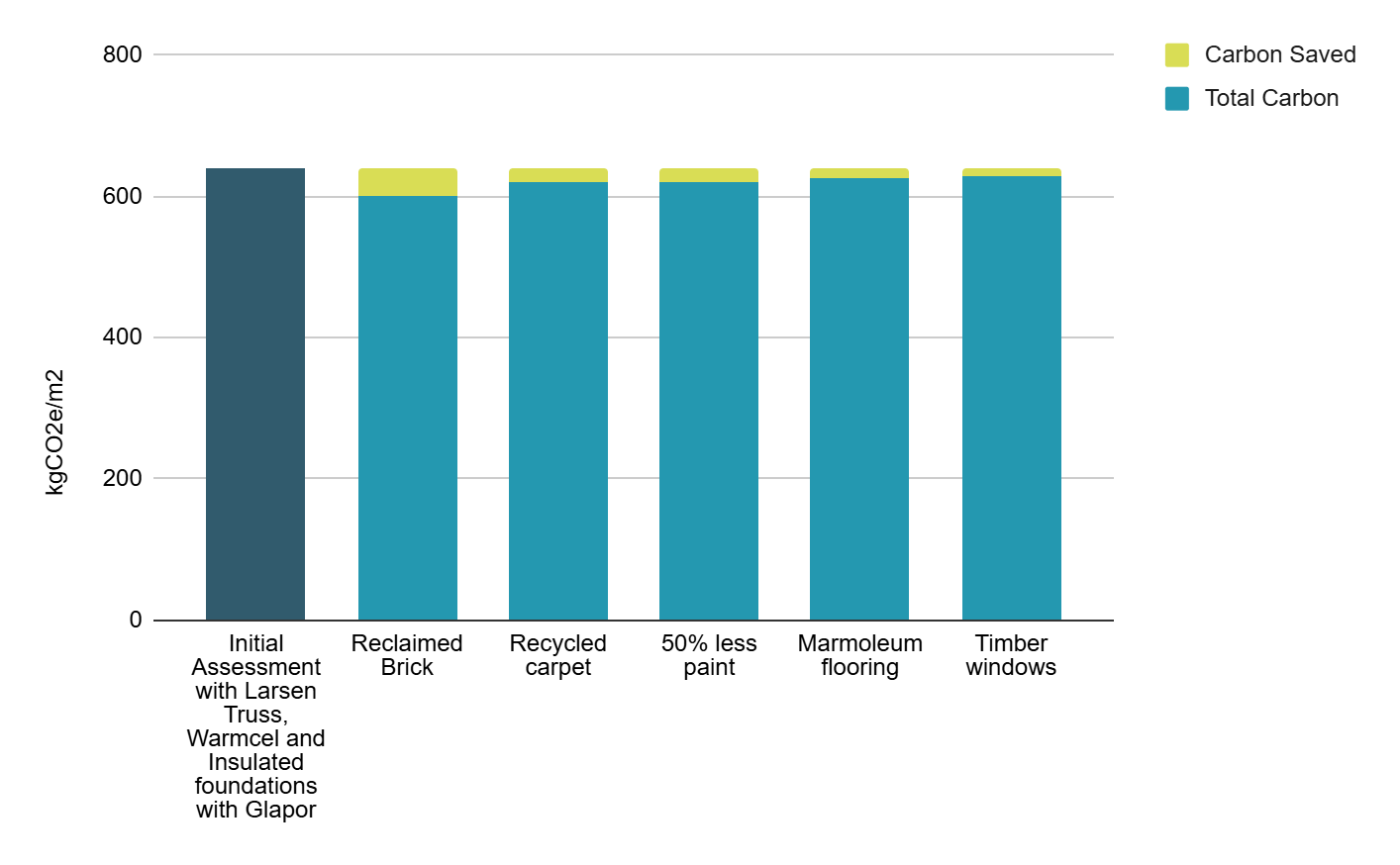
In addition, internal finishes were another significant consideration, with opportunities arising later in the process to refine material choices. These also played a significant role in reducing the impacts, especially during the later stages where every bit of carbon saved helped Prosiect Bontnewydd achieve their goal.
We outline material considerations and their impacts in the tables below.
Low-Carbon Landscaping
| Material Option | Lifecycle Carbon Change (kgCO₂e/m²) | % of Embodied Carbon Saved | Advantages | Disadvantages | Design Issues and Constraints |
|---|---|---|---|---|---|
| All aggregates sourced on site | -87 | 12.6% | Creates little transport impacts for aggregates and reduces total carbon impacts massively. | There's the potential of needing storage on site for the aggregates which may not be possible. | The design team was unsure as to how much aggregate would be available to reuse from the project's site. |
| Replacing coloured asphalt with reclaimed block paving | -36 | 5.2% | Reclaimed block paving had a much lower embodied carbon and can be locally sourced. | Will require more time-consuming installation and can shift overtime causing uneven surfaces. | Dependent on local supply and the area required to be covered. May also affect accessibility in some areas. |
| Reclaimed block paving | -20 | 2.9% | Reclaimed block paving does the exact same thing as regular block paving whilst reducing carbon impacts. | There is a limited local supply, and outsourcing supplies may increase the carbon of the reclaimed materials. | — |
| All 20% RAP Asphalt | -19 | 2.8% | Much like GGBS in concrete, RAP Asphalt is recycling waste material, reducing its carbon impacts compared to standard asphalt. | Similarly to GGBS, depending on the source of the recycled material, the environmental benefits can vary. There is also an increased chance of contamination. | — |
| Concrete replacing asphalt | -16 | 2.3% | Concrete requires thinner sections compared to asphalt and is considered more 'durable', reducing its maintenance carbon figure. | Concrete is still high impact and harder to repair compared to asphalt so if maintenance is required, it can increase the carbon drastically. | There are safety benefits that asphalt has compared to concrete such as reduced chance of slipping when wet and the heat absorbed; concrete gets much hotter than asphalt. |
| 10% coloured asphalt replaced with bark soft landscaping | -8 | 1.2% | Can increase biodiversity and has a reduction in embodied carbon due to reducing the hard landscaping. | May need to be topped up and maintained more often. May increase plastic waste if sourced and delivered in plastic bags. | Reduces the hard landscaping area and may become inaccessible in wet weather conditions. |
| Turf instead of MUGA | -5 | 0.7% | This reduces the carbon and creates a greener landscape without the increased maintenance and issues that comes with soft landscaping. | The quality of the turf is dependent on the price, meaning it can become incredibly expensive. | — |
| 20% RAP asphalt surface course to MUGA pitch | -5 | 0.7% | RAP asphalt uses recycled material, reducing its environmental impacts. | Similarly to GGBS, depending on the source of the recycled material, the environmental benefits can vary. There is also an increased chance of contamination. | Results in a harder finish compared to rubberised tarmac, which may be unsuitable for some sports. |
| Porous Asphalt | +17 | +2.5% | Have lower impacts than porous paving and can reduce the chance of water freezing, decreasing the chance of slipping. It also reduces runoff and can help remove pollutants from water. | Can require increased maintenance if not cared for correctly. If maintained incorrectly, it can become clogged and restrict water flow. | — |
All aggregates sourced on site
- Lifecycle Carbon Change (kgCO₂e/m²)
- -87
- % of Embodied Carbon Saved
- 12.6%
Show detailHide detail
Advantages
Creates little transport impacts for aggregates and reduces total carbon impacts massively.
Disadvantages
There's the potential of needing storage on site for the aggregates which may not be possible.
Design Issues and Constraints
The design team was unsure as to how much aggregate would be available to reuse from the project's site.
Replacing coloured asphalt with reclaimed block paving
- Lifecycle Carbon Change (kgCO₂e/m²)
- -36
- % of Embodied Carbon Saved
- 5.2%
Show detailHide detail
Advantages
Reclaimed block paving had a much lower embodied carbon and can be locally sourced.
Disadvantages
Will require more time-consuming installation and can shift overtime causing uneven surfaces.
Design Issues and Constraints
Dependent on local supply and the area required to be covered. May also affect accessibility in some areas.
Reclaimed block paving
- Lifecycle Carbon Change (kgCO₂e/m²)
- -20
- % of Embodied Carbon Saved
- 2.9%
Show detailHide detail
Advantages
Reclaimed block paving does the exact same thing as regular block paving whilst reducing carbon impacts.
Disadvantages
There is a limited local supply, and outsourcing supplies may increase the carbon of the reclaimed materials.
Design Issues and Constraints
—
All 20% RAP Asphalt
- Lifecycle Carbon Change (kgCO₂e/m²)
- -19
- % of Embodied Carbon Saved
- 2.8%
Show detailHide detail
Advantages
Much like GGBS in concrete, RAP Asphalt is recycling waste material, reducing its carbon impacts compared to standard asphalt.
Disadvantages
Similarly to GGBS, depending on the source of the recycled material, the environmental benefits can vary. There is also an increased chance of contamination.
Design Issues and Constraints
—
Concrete replacing asphalt
- Lifecycle Carbon Change (kgCO₂e/m²)
- -16
- % of Embodied Carbon Saved
- 2.3%
Show detailHide detail
Advantages
Concrete requires thinner sections compared to asphalt and is considered more 'durable', reducing its maintenance carbon figure.
Disadvantages
Concrete is still high impact and harder to repair compared to asphalt so if maintenance is required, it can increase the carbon drastically.
Design Issues and Constraints
There are safety benefits that asphalt has compared to concrete such as reduced chance of slipping when wet and the heat absorbed; concrete gets much hotter than asphalt.
10% coloured asphalt replaced with bark soft landscaping
- Lifecycle Carbon Change (kgCO₂e/m²)
- -8
- % of Embodied Carbon Saved
- 1.2%
Show detailHide detail
Advantages
Can increase biodiversity and has a reduction in embodied carbon due to reducing the hard landscaping.
Disadvantages
May need to be topped up and maintained more often. May increase plastic waste if sourced and delivered in plastic bags.
Design Issues and Constraints
Reduces the hard landscaping area and may become inaccessible in wet weather conditions.
Turf instead of MUGA
- Lifecycle Carbon Change (kgCO₂e/m²)
- -5
- % of Embodied Carbon Saved
- 0.7%
Show detailHide detail
Advantages
This reduces the carbon and creates a greener landscape without the increased maintenance and issues that comes with soft landscaping.
Disadvantages
The quality of the turf is dependent on the price, meaning it can become incredibly expensive.
Design Issues and Constraints
—
20% RAP asphalt surface course to MUGA pitch
- Lifecycle Carbon Change (kgCO₂e/m²)
- -5
- % of Embodied Carbon Saved
- 0.7%
Show detailHide detail
Advantages
RAP asphalt uses recycled material, reducing its environmental impacts.
Disadvantages
Similarly to GGBS, depending on the source of the recycled material, the environmental benefits can vary. There is also an increased chance of contamination.
Design Issues and Constraints
Results in a harder finish compared to rubberised tarmac, which may be unsuitable for some sports.
Porous Asphalt
- Lifecycle Carbon Change (kgCO₂e/m²)
- +17
- % of Embodied Carbon Saved
- +2.5%
Show detailHide detail
Advantages
Have lower impacts than porous paving and can reduce the chance of water freezing, decreasing the chance of slipping. It also reduces runoff and can help remove pollutants from water.
Disadvantages
Can require increased maintenance if not cared for correctly. If maintained incorrectly, it can become clogged and restrict water flow.
Design Issues and Constraints
—
Low-Carbon Finishes — Reclaimed brick, recycled carpet, flooring & windows
| Material Option | Lifecycle Carbon Change (kgCO₂e/m²) | % of Embodied Carbon Saved | Advantages | Disadvantages | Design Issues and Constraints |
|---|---|---|---|---|---|
| Reclaimed Brick | -39 | 5.7% | Reclaimed materials serve the same purpose as the virgin alternative but without the high carbon impacts. | If not locally supplied, may not have such a drastic effect on the carbon. Depends on supply and demand of the material locally. | There is an amount of brick available from the demolitions but storing them on site during construction may prove difficult. |
| Recycled Carpets | -18 | 2.6% | Reduces the impacts involved in manufacturing carpet and can create a bigger demand for recycled materials, encouraging manufacturers to increase supply. | There is a limited supply and may not be able to be sourced locally. This may reduce the carbon benefits from this choice. | Local supply is incredibly low and may not be available at the time and scale required. |
| 50% less paint | -17 | 2.5% | Paint can require regular maintenance due to cracking, chipping and peeling, especially in rooms that have high footfall. Reducing the area of paint reduced the initial impacts and the maintenance impacts. | If the finish of the wall is not durable or suitable to be left, it can cause even more maintenance carbon in the building's lifetime. | Will need to be investigated based on the walls and their finish as to whether it will be suitable. |
| Marmoleum Flooring | -12 | 1.7% | Marmoleum flooring is easy to clean and long-lasting, with a lifespan of 50 years. It's made using natural and renewable materials and is recyclable at the end of its life. | Can be expensive and require an experienced installer. It also requires regular maintenance and lacks design options. | — |
| Timber Windows | -10 | 1.4% | They are better thermally while decreasing the carbon impacts. | It may be suitable in certain areas, but it can depend on the envisioned design. | Could consider using alu-clad timber windows to reduce the amount of aluminium used, increase the timber, while still having similar durability to fully steel/aluminium windows. |
Reclaimed Brick
- Lifecycle Carbon Change (kgCO₂e/m²)
- -39
- % of Embodied Carbon Saved
- 5.7%
Show detailHide detail
Advantages
Reclaimed materials serve the same purpose as the virgin alternative but without the high carbon impacts.
Disadvantages
If not locally supplied, may not have such a drastic effect on the carbon. Depends on supply and demand of the material locally.
Design Issues and Constraints
There is an amount of brick available from the demolitions but storing them on site during construction may prove difficult.
Recycled Carpets
- Lifecycle Carbon Change (kgCO₂e/m²)
- -18
- % of Embodied Carbon Saved
- 2.6%
Show detailHide detail
Advantages
Reduces the impacts involved in manufacturing carpet and can create a bigger demand for recycled materials, encouraging manufacturers to increase supply.
Disadvantages
There is a limited supply and may not be able to be sourced locally. This may reduce the carbon benefits from this choice.
Design Issues and Constraints
Local supply is incredibly low and may not be available at the time and scale required.
50% less paint
- Lifecycle Carbon Change (kgCO₂e/m²)
- -17
- % of Embodied Carbon Saved
- 2.5%
Show detailHide detail
Advantages
Paint can require regular maintenance due to cracking, chipping and peeling, especially in rooms that have high footfall. Reducing the area of paint reduced the initial impacts and the maintenance impacts.
Disadvantages
If the finish of the wall is not durable or suitable to be left, it can cause even more maintenance carbon in the building's lifetime.
Design Issues and Constraints
Will need to be investigated based on the walls and their finish as to whether it will be suitable.
Marmoleum Flooring
- Lifecycle Carbon Change (kgCO₂e/m²)
- -12
- % of Embodied Carbon Saved
- 1.7%
Show detailHide detail
Advantages
Marmoleum flooring is easy to clean and long-lasting, with a lifespan of 50 years. It's made using natural and renewable materials and is recyclable at the end of its life.
Disadvantages
Can be expensive and require an experienced installer. It also requires regular maintenance and lacks design options.
Design Issues and Constraints
—
Timber Windows
- Lifecycle Carbon Change (kgCO₂e/m²)
- -10
- % of Embodied Carbon Saved
- 1.4%
Show detailHide detail
Advantages
They are better thermally while decreasing the carbon impacts.
Disadvantages
It may be suitable in certain areas, but it can depend on the envisioned design.
Design Issues and Constraints
Could consider using alu-clad timber windows to reduce the amount of aluminium used, increase the timber, while still having similar durability to fully steel/aluminium windows.
Achieving Carbon Reductions Through Smart Design
LCD Consulting's whole-life carbon approach embedded sustainability at every stage of Prosiect Bontnewydd's sustainable school design. By focusing on:
- ✓Sustainable material selection — prioritising low-carbon materials like EcoCrete, Warmcel insulation, and timber structures.
- ✓Circular economy principles — reusing reclaimed bricks, block paving, and recycled carpets to minimise waste.
- ✓Optimising the construction process — refining substructure, superstructure, and finishes to cut emissions.
Conclusion
Prosiect Bontnewydd proves that with early planning, cross-team collaboration, and a flexible approach to material selection, meaningful carbon reductions are achieved without compromising quality.
By integrating sustainable design principles and innovative construction methods, LCD Consulting helped deliver a low-carbon, future-proofed school and community centre, providing a model for future projects.